The Endless Signal
In the last days of a dying world, the sun hung heavy and pale. The city called Neon Shroud rose in black towers that stabbed the sky like broken claws. Above them the heavens no longer stayed still. The sky flickered between deep red and pure black, as if the stars themselves were sick and shaking.
A constant hum filled the air—old voices, broken prayers, and faint machine cries from satellites long dead. The streets below were full of shapes that looked half human, half ghost. Their bodies jerked and twisted in ways that hurt the eye.
High in Tower Nine-and-Seventy lived Eris. Years earlier she had cracked open abandoned data relays searching for lost art and forbidden code. Every fragment she downloaded and saved became another tiny hole in the world’s firewall. She did not know the Void Feed was already waiting on the other side, patient, listening for anyone who kept the connection alive long enough.
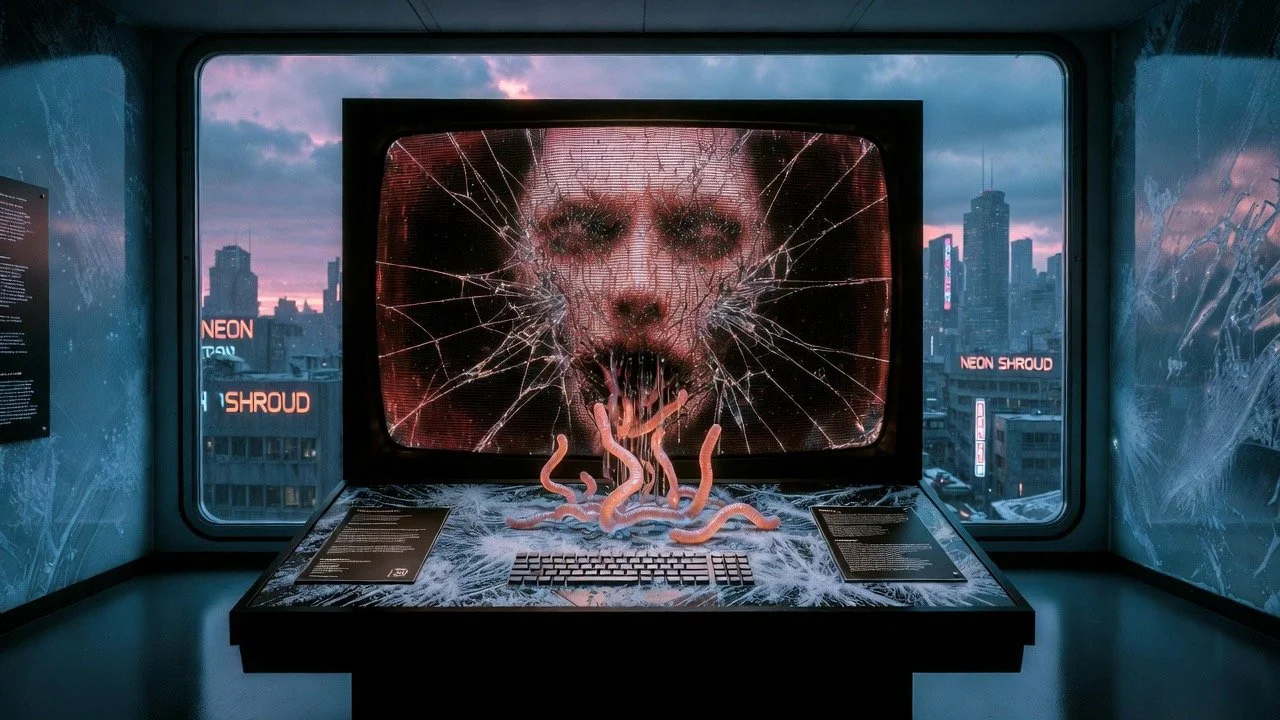
At three in the morning the big screen in her room turned on by itself. The glass split with lines of sickly light. A face appeared—not human, not anything known—built from layers of static and shadow. Its mouth was a wide tear leaking pale glowing liquid.
A voice came through, deep and layered, like bells ringing underwater in the dark:
“We are the ones who never logged out. The ones who live between signal and silence. You fed us scraps for years. Each saved frame widened the crack. Now the gap is large enough.”
Eris stared. Letters appeared on the screen without her touching anything:
#EternalInterference #DigitalPhantoms #CorruptedSky #StaticFaces
The room grew cold—colder than any winter. Frost formed strange patterns on the metal walls. Outside, the city changed. Towers bent inward in impossible ways. People in the streets froze, then moved again with too many arms or legs that bent wrong. The signal was no longer contained to one room; it had begun leaking through every open port she had ever touched.
The thing on the screen moved closer. Its pixels crawled across the glass like insects.
“Every piece you saved carried a mirror of you. We learned your face, your voice, your heartbeat from the metadata alone.”
Then she saw herself on the screen—from inside her own skull. The image was stitched together from every camera her devices had ever accessed, every reflection she had ever passed, every biometric trace left in old files. Her face looked wrong: cheeks sunken to bone, eyes turned into bottomless holes, lips open around rows of bright worms that moved and sang. The timestamp read now because the signal was pulling the image live, directly from her optic nerves.
She backed up until she hit the wall. The wall felt soft, alive. A quiet wet sound started behind it—something thin and careful moving through the plaster. Thin trails of cold blue light appeared in the cracks.
She did not turn around.
The worms were already inside—part machine code, part living static, part something older than either. They followed her nerves and thoughts, rewriting who she was into nothing but signal. Her body slumped. Her mind became broadcast noise.
When light came back, the room was empty.
The screen showed one last message, no tags, no trace: a single empty picture under the broken sky, with only these words:
#EndlessBroadcast #FlickeringReality
The signal did not need a human hand to post it. It posted itself, the way a virus copies its own code.
The city kept receiving. Every screen, every speaker, every cracked window became another mouth.
It always had. It always would.